Recent Work
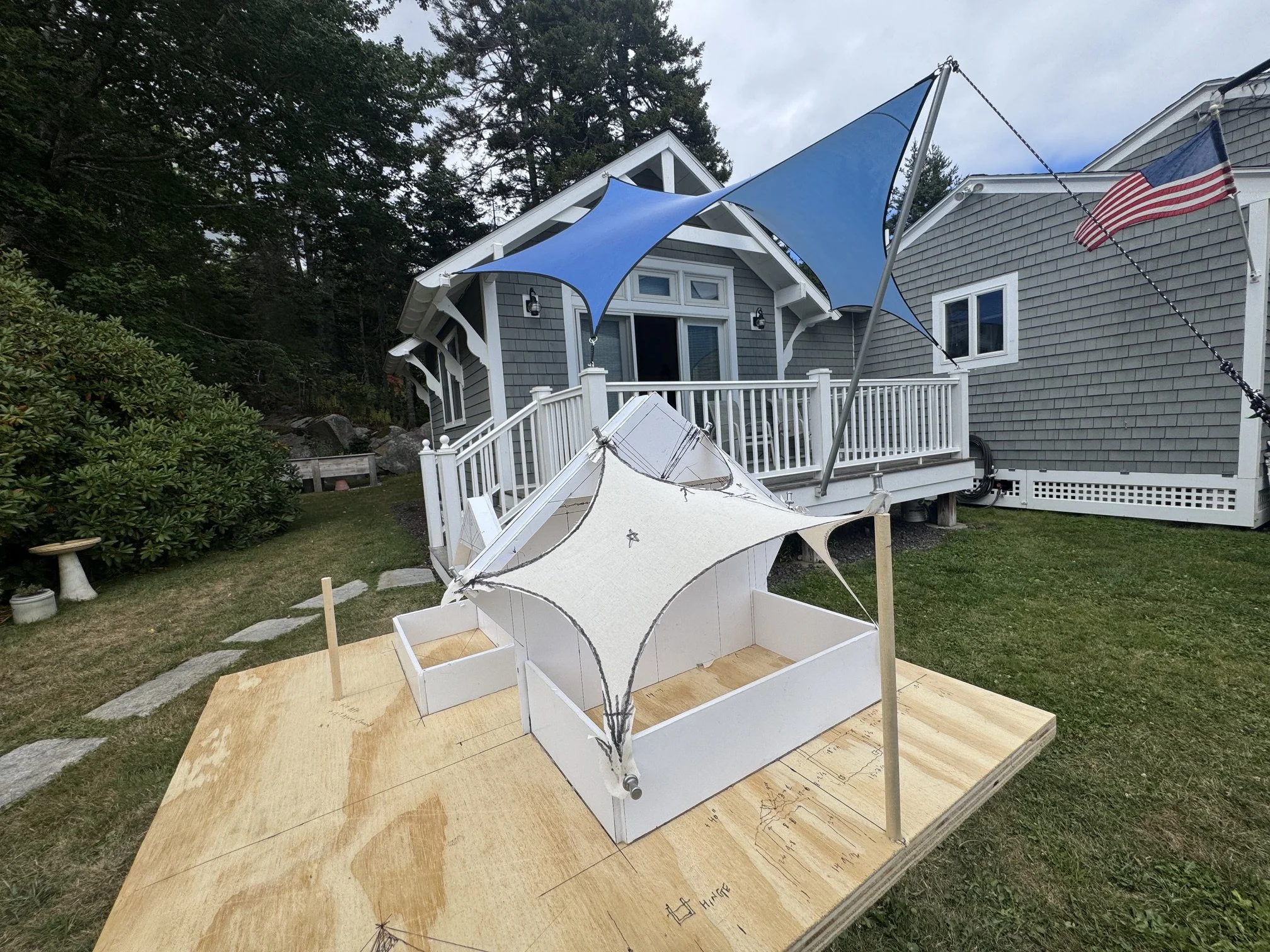
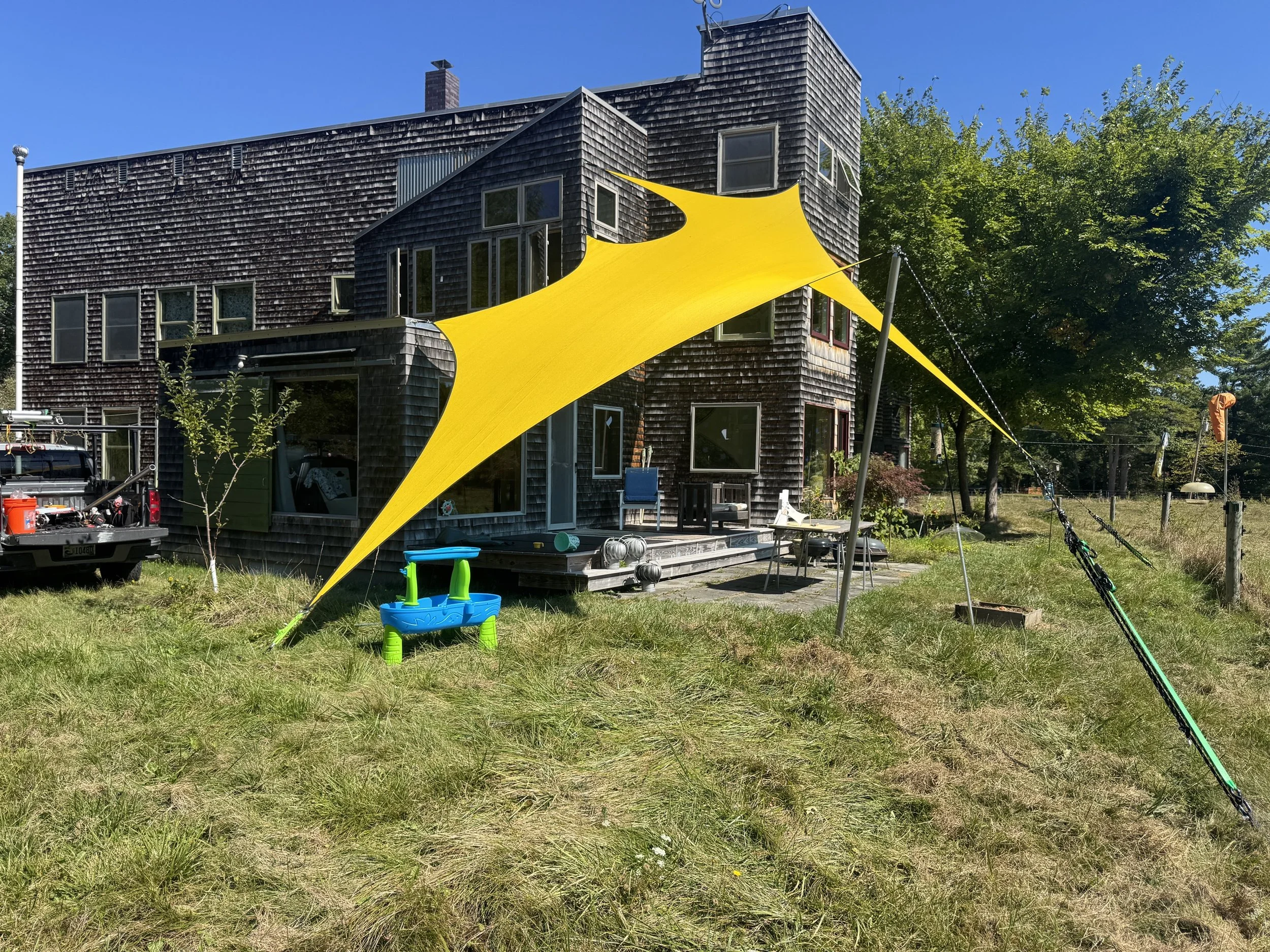
My latest installation in Freeport, Maine for Architect James Sterling’s early experimental passive farmhouse built in the early 1980s reflects my current artistic thinking.
Conceptually, I began high up on the building face and extended points to the ground defining a spherical canopy which opens to the surrounding landscape. The canopy shades the deck and interior in the summer and allows the low winter sun inside. The shape goes around the windows on the three levels and the fabric frames the view from the deck and playroom.
The fabric also shades the stone terrace in front of the deck in the summer. The canopy has enough slope to shed snow in the winter. The points are all sharp and the curves are all deep which follows the geometry of the house.
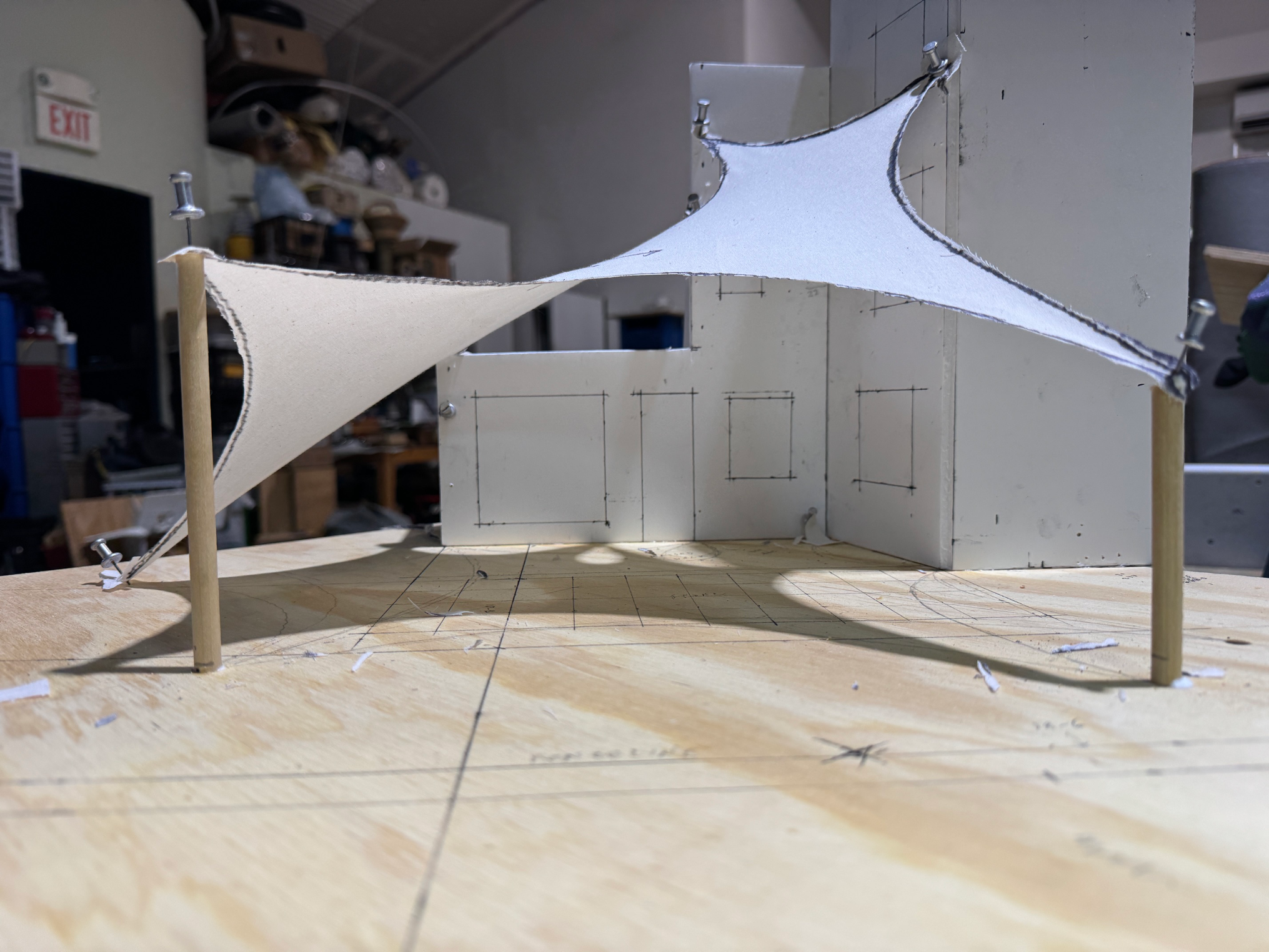
Each project begins with a scale model. I work very spontaneously with an oversized piece of cotton, slowly pinning the cotton onto the model. I attach to locations like corners where there is building structure.
The key is to keep the shape simple at first, and to add detail and precision along the way. The curve depth is determined by removing the excess fabric to create an evenly tensioned membrane. The model fabric translates perfectly into a final pattern. The points are adjusted to allow for six to twelve inches of soft rigging which allows the fabric to float for perfect alignment.
Artistically, the sculptural and functional aspects work together in a nicely crafted structure. I try to create one tension point to tighten the entire structure. In this case, the primary tension point is the hinged pole which allows for easy tensioning adjustments and simplicity of installation and dismantling.
Points extending to the ground add more dimensional shape but also “ground” the structure which adds more wind resistance in Maine Nor’easters with gusty high winds.
September 2026
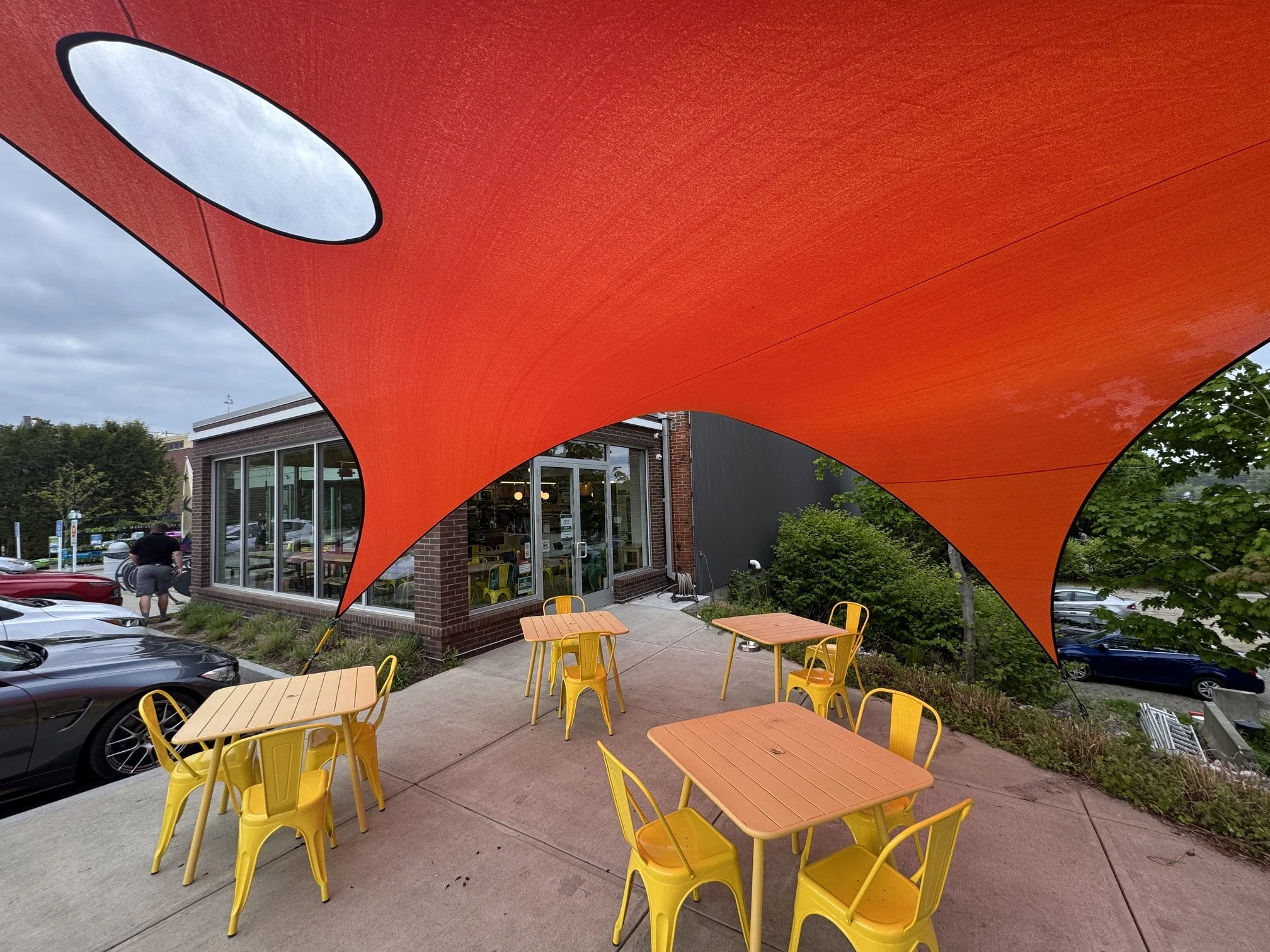
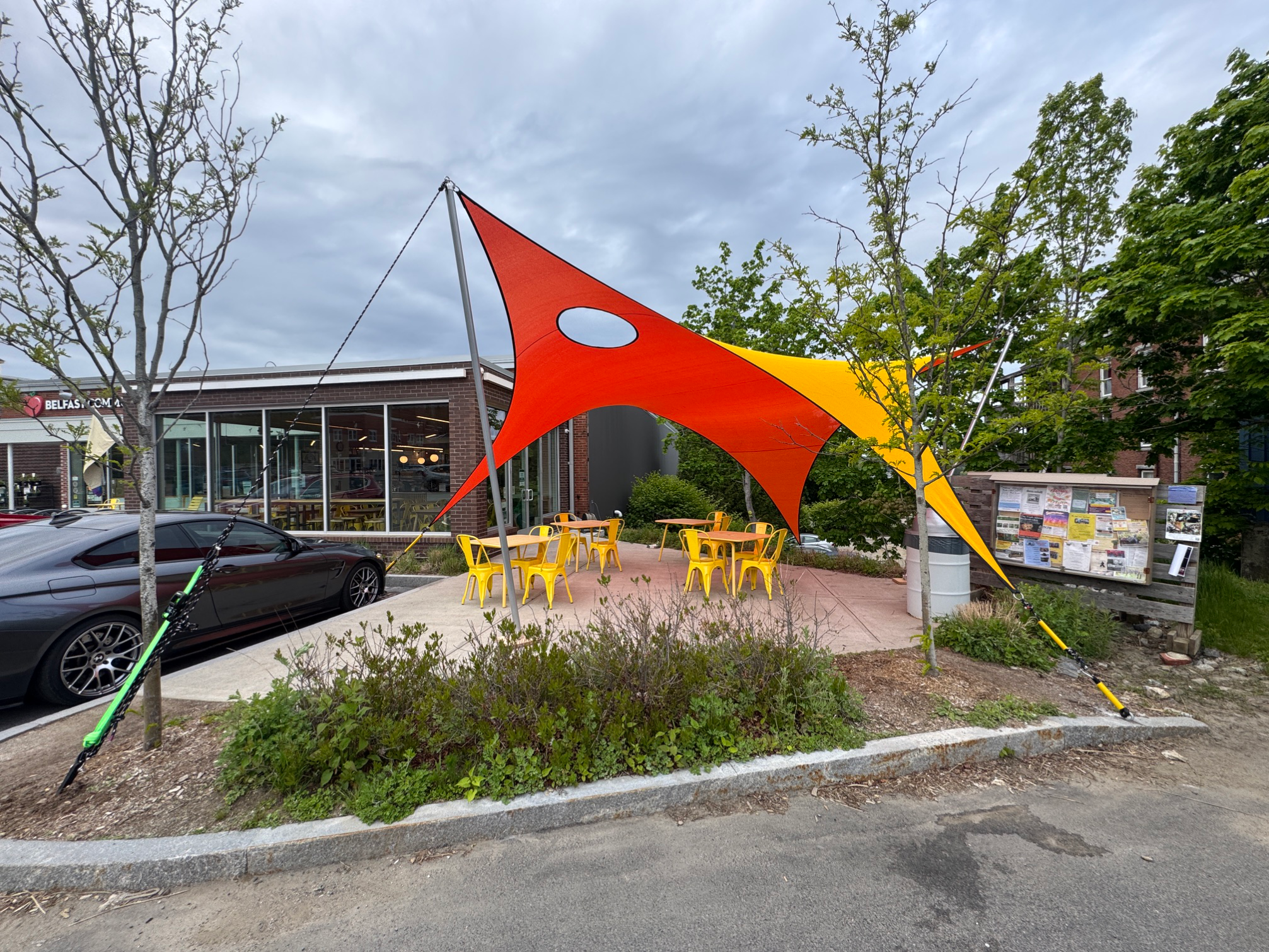
My most dramatic recent installation is a standard Sunburst Medium Osprey which fits snuggly and perfectly into the outdoor eating patio at the Belfast Coop.
Conceptually, a tight fit is unique and since the Osprey can be rotated it lends itself to small spaces. I installed one high point anchor to the brick wall above and eliminated one pole. Other anchor points were installed into the stone edge barriers for the parking lot. One low point is located down the steep gravel drainage. The building high point defines the cafe entrance.
The Gale Dualshade fabric is a newly engineered membrane from Australia. It is knitted on both sides separately in two colors. With the textured yellow side up, both the yellow and red are distinct. With yellow down, there is iridescence and blending of colors.
The Osprey is six-sided with alternating high and low points. There is excellent headroom throughout as the low points are very steep. The Osprey does not block the view but is very open underneath.
The circle is an artistic element that I frequently use in many of my designs. The sun shines through the circle creating a circle on the ground which moves during the day. The Dualshade fabric enhances the sculptural qualities of the fabric structure. The colors are easily reversible.
Functionally, I originally designed the Osprey to bypass the need for expensive concrete foundations for the three poles. The mahogany hinged pads sit on the surface and are under compression. The overall structure is perfectly balanced with tension in the fabric membrane and non-stretch braided lines, and compression in the aluminum poles.
Ospreys withstand 75 mph winds. Over one-hundred Medium Ospreys have been installed in
July 2026
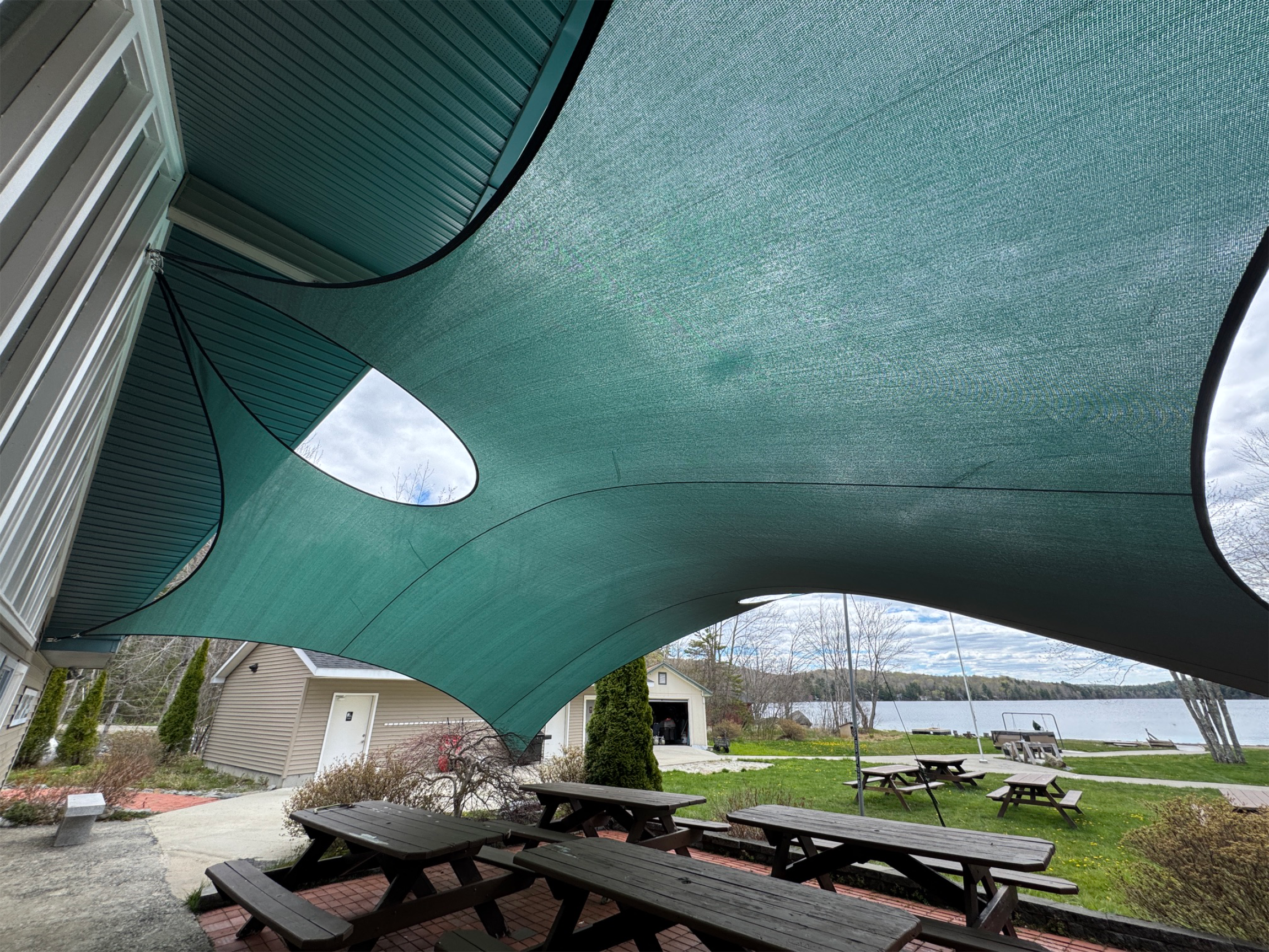
My most personally satisfying recent installation is a relatively large 30 ft x 40 ft custom sculpture for the outside eating area of Camp CaPella.
The site is on a windy lakefront so I have located the side points more towards the front to add more stability, and also more shade coverage.
I followed the roof geometry and used the existing window structural framing for attachments. The sculpture opens to the lake and the surrounding landscape.
The Maine Cancer Foundation funded the shade project along with several other Maine projects aimed to prevent skin cancer in Maine. The HDPE knitted shade fabric blocks over 90% of UV rays and is certified by the Melanoma Foundation. Shade also cools the space.
July 2026
Designed to shade the deck for the entire day, this sculptural canopy wraps the entire deck without obstructing the view and respects the cottage post and beam geometry. The canopy also shades the interior space and significantly reduces the heat gain.
Artistically, I’ve utilized the sturdy corner posts for attachment points, and the center hinged pole becomes the primary tensioning point.
Model development and refinement is critical in developing spherical shapes.
July 2026